By Grocery List Plus Editorial Staff | Published on June 14, 2026
480 min
70-Percent Hydration Bread
Recipe GLPR141887ab650758
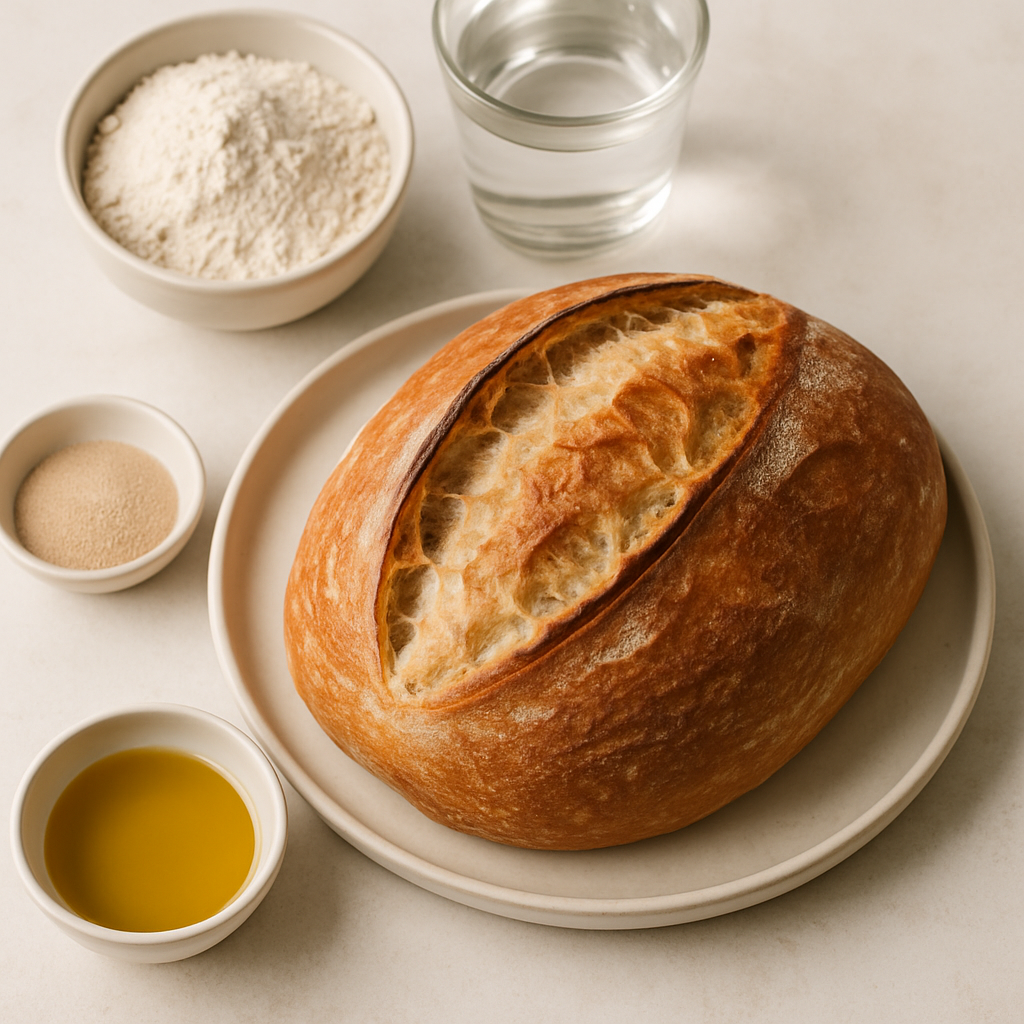
A rustic, artisan-style bread made with a 70-percent hydration dough that develops a chewy crumb and crispy crust. This classic formula uses just flour, water, yeast, salt, and olive oil for a simple yet flavorful loaf. The long fermentation time allows the dough to develop deep flavor and excellent texture.
Save recipes you love
Create a free Grocery List Plus account to save recipes, rate them, and add every ingredient to your grocery list in one tap.
Ingredients
20 ounces bread flour
14 ounces water
1 teaspoon instant yeast
1½ teaspoons salt
1 tablespoon olive oil
Directions
In a large mixing bowl, combine the bread flour, instant yeast, and salt. Stir to distribute the yeast and salt evenly throughout the flour.
Add the water and olive oil to the flour mixture. Mix with your hands or a wooden spoon until all the flour is hydrated and a shaggy, wet dough forms. Make sure no dry flour remains at the bottom of the bowl.
Cover the bowl with a damp kitchen towel or plastic wrap and let the dough rest at room temperature for 30 minutes. This autolyse period allows the flour to fully absorb the water.
After the rest, perform a series of stretch-and-folds. Wet your hand, reach into the dough, and gently stretch one side up and fold it over the top. Rotate the bowl and repeat from all four sides. Rest for 30 minutes and repeat this process 3–4 times over the course of 2–3 hours.
Once the dough has increased in volume by about 50–75% and shows visible bubbles on the surface, it is ready for bulk fermentation. Let it continue to rise at room temperature until it has roughly doubled in size, typically 4–6 hours total depending on room temperature.
Transfer the dough to a lightly floured work surface. Gently shape it into a round or oval loaf by folding the edges toward the center, creating tension on the surface. Be careful not to overwork the dough.
Place the shaped dough seam-side up in a floured banneton basket or bowl lined with a kitchen towel. Cover loosely and let it proof at room temperature for 1–2 hours, or until it shows gentle resistance when poked and a slight spring-back occurs.
Preheat your oven to 450°F with a Dutch oven inside for at least 30 minutes.
Carefully turn the dough out of the banneton onto parchment paper. Score the top with a sharp knife in a cross-hatch or slash pattern to control expansion during baking.
Transfer the dough on parchment paper into the preheated Dutch oven. Cover with the lid and bake for 20 minutes to trap steam and promote a crispy crust.
Remove the Dutch oven lid and bake for an additional 25–30 minutes until the crust is deep golden brown.
Remove the bread from the oven and let it cool on a wire rack for at least 1 hour before slicing to allow the interior to set properly.
Comments
This is an honest, ingredient-smart recipe that any Charlotte grocer stocks, and the cost per loaf runs under two dollars. The stated time is genuinely misleading: 480 minutes (8 hours) ignores the reality that bulk fermentation alone consumes 3–4 hours, shaping takes another 20 minutes, and final proof another 2–3 hours, making this a two-day project with heavy hands-on work in the middle, not a passive recipe. The dough requires attention during stretches and turns and will not tolerate neglect, so this is not a set-and-forget weeknight dinner bread. It does reheat beautifully and yields multiple servings, but the time honesty and active supervision disqualify it from top marks.
Sign in or create a free account to add your review.